
Australian hotel · Anonymous deployment · 3 Aug–27 Sep 2026
Hotel cleaning robots in Australia: what 43,903 m² of real cleaning data shows
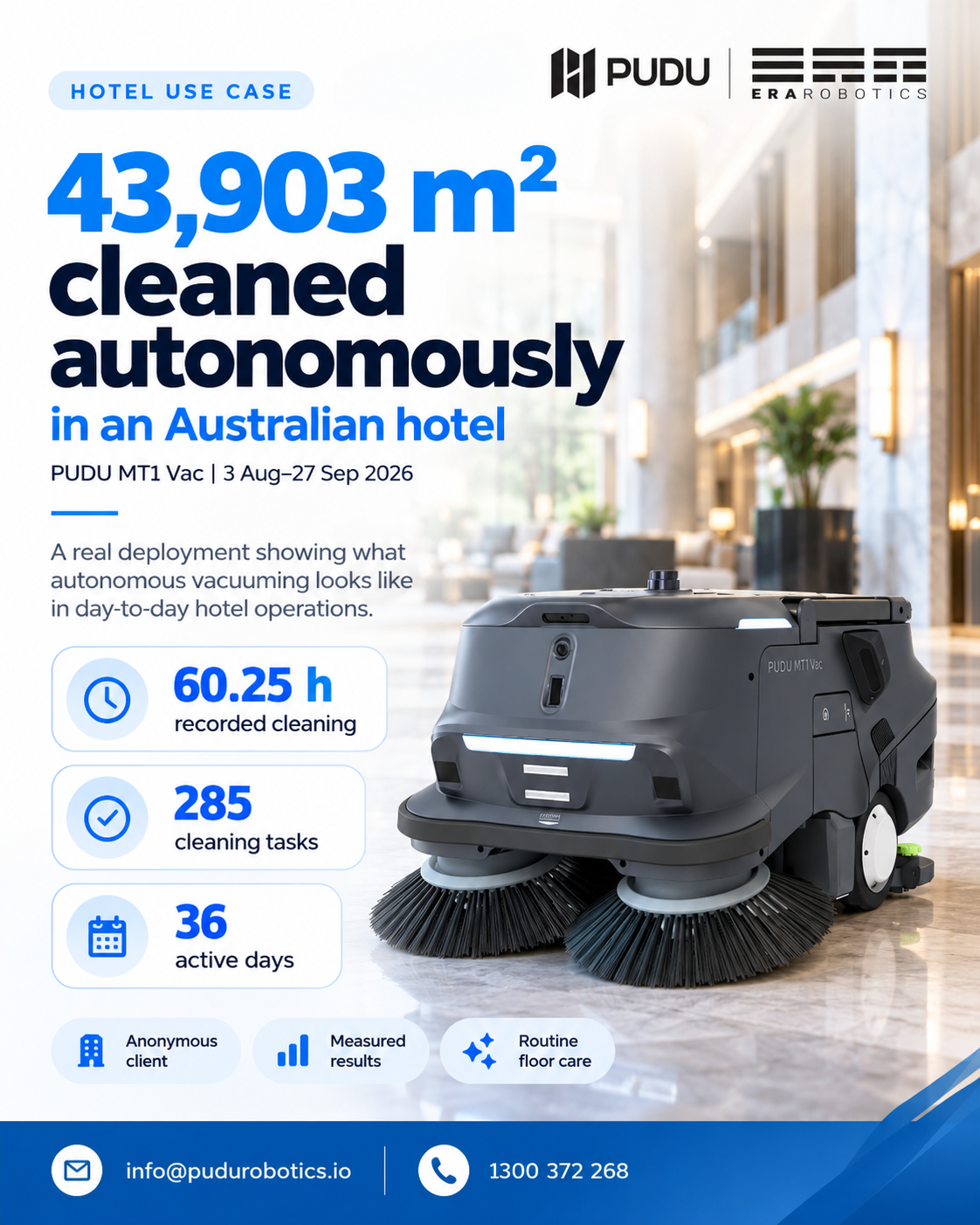
43,903 m² of cumulative recorded autonomous cleaning activity. 60.25 hours. 285 tasks. A real-world look at a PUDU MT1 Vac supporting routine hotel floor care.
43,903 m²
Cumulative recorded cleaning activity
Across repeated tasks and routes
60.25 h
Recorded autonomous cleaning time
During the reporting window
285
Cleaning tasks
Across 36 active days
1,219.5 m²
Average per active day
Recorded area ÷ 36 days
What does a hotel cleaning robot actually do?
What happens after the demonstration? From 3 August to 27 September 2026, a PUDU MT1 Vac supported routine floor cleaning at an anonymous Australian hotel. ERA Robotics reviewed recorded cleaning area, operating time and tasks to understand how autonomous hotel vacuuming fitted into daily operations.
Guest requests, inspections, room presentation, spills and unexpected issues still need people. Repeatable floor-care routes are where a commercial cleaning robot can assist. The aim is to identify what can be automated reliably and what should stay with the team.
The results: repeatable cleaning, measured
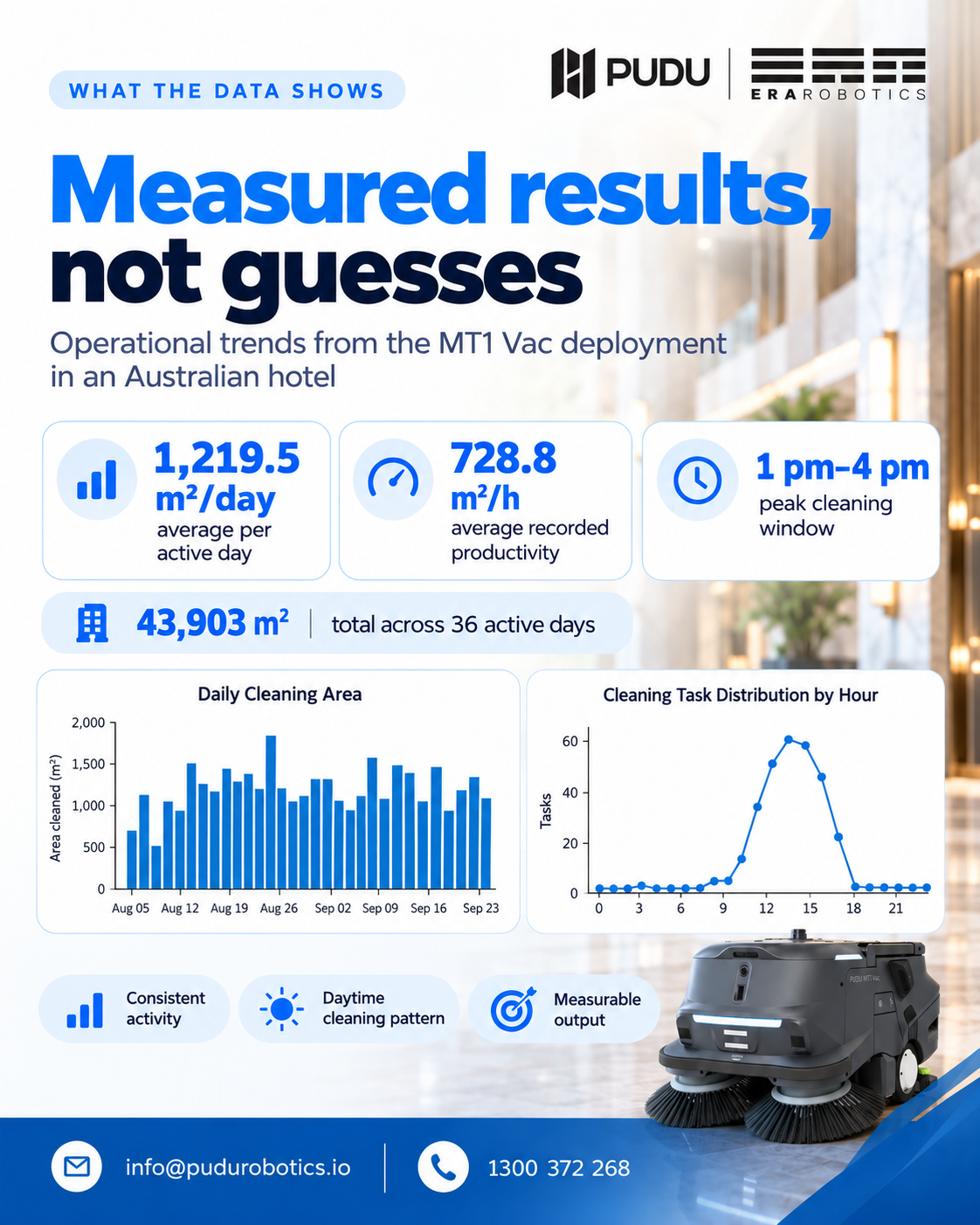
The robot recorded 43,903 m² of cumulative cleaning activity over 36 active days, completing 285 tasks in 60.25 recorded hours. That area is the sum of work over repeated routes; it does not mean the property has 43,903 m² of unique floor space.
The average was approximately 1,219.5 m² per active day and 728.7 m² per recorded cleaning hour (43,903 ÷ 60.25). The hourly figure describes this deployment's recorded productivity, not a manufacturer's maximum speed or a guaranteed result at another hotel.
Actual results vary with floor surfaces, furniture, obstacles, routes and guest traffic. A site assessment and pilot are more useful than choosing from a specification sheet alone.
When was the robot used?
Cleaning activity was concentrated during the day, with the strongest task activity approximately 1 pm–4 pm. Autonomous cleaning does not have to be limited to overnight work. The appropriate window depends on housekeeping routines, guest traffic, available routes and the hotel's own operating constraints.
Records of area, time and task count make hospitality cleaning automation easier to review. They provide evidence of work performed, rather than assuming a scheduled area was cleaned.
Robots handle the routine. People handle the detail.
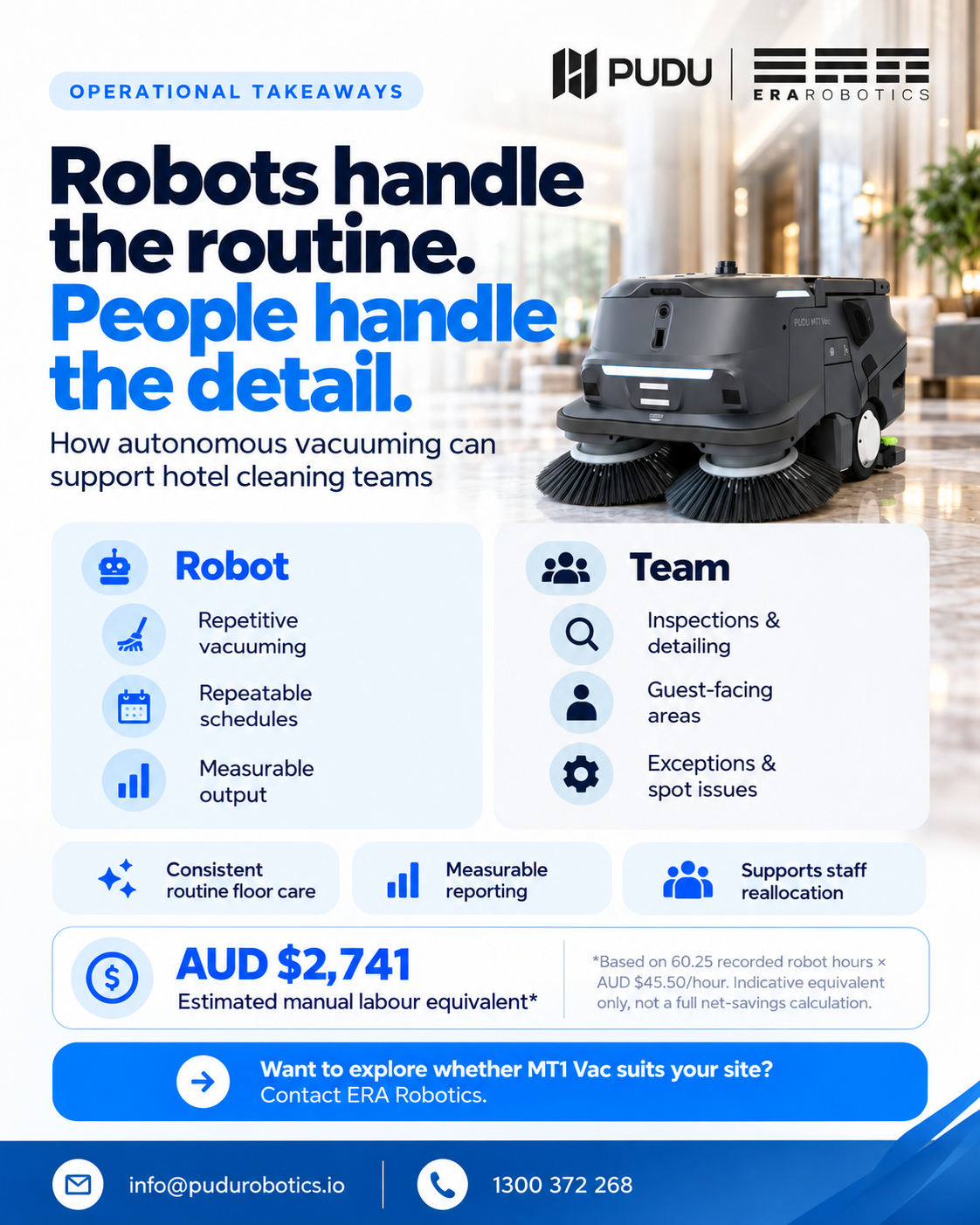
This deployment illustrates a human-plus-robot workflow rather than a claim that a robot replaces hotel cleaners.
Robot
Repetitive vacuuming, repeatable routes, scheduled floor care and measurable output.
Team
Inspections, detailing, guest-facing spaces, spot cleaning, exceptions and decisions requiring judgement.
The PUDU MT1 Vac is designed for commercial vacuuming on carpet and hard floors, with autonomous navigation in mapped environments. Potential hotel applications include guest-floor corridors, circulation areas and selected back-of-house routes. Read the MT1 Vac product details and our cleaning robot range to compare approaches.
What could 60.25 hours represent in labour cost?
At an indicative AUD $45.50 per hour (AUD $35 base hourly cost plus 30%), the 60.25 recorded robot hours represent approximately AUD $2,741 of manual labour equivalent.
This is not confirmed net savings. The calculation, 60.25 × $45.50, does not account for intervention, existing workflows, equipment or how staff hours were actually reallocated. For a site-specific financial assessment, use the Robot Financial Impact calculator; its estimates should likewise be reviewed against your real costs.
Could autonomous vacuuming work in your hotel?
Every property differs. Corridors, lifts, carpet, hard flooring, furniture, traffic, schedules and staffing determine where hotel cleaning robots can help—and where they cannot. ERA Robotics can review your site, identify suitable routes and assess whether the PUDU MT1 Vac fits your operation.
Hotel cleaning robot questions
Can robots vacuum hotel carpets?
Commercial robotic vacuum cleaners such as the PUDU MT1 Vac are designed for carpet and hard-floor environments, subject to the property's specific flooring, layout and cleaning requirements.
Can cleaning robots replace hotel cleaners?
The practical use case is automating suitable repetitive floor-care tasks. Hotel teams still handle detailed cleaning, inspections, guest-facing work and unexpected issues.
How much area can a hotel cleaning robot clean?
It depends on the site. In this anonymous Australian hotel deployment, the robot recorded 43,903 m² of cumulative activity across 36 active days, averaging approximately 1,219.5 m² per active day. This is repeated cleaning activity, not unique floor area.
How much can a hotel save using a cleaning robot?
Savings depend on the hotel's labour model, staff reallocation and robot costs. Here, 60.25 recorded robot hours equate to approximately AUD $2,741 of indicative manual labour cost at AUD $45.50/hour. This is not confirmed net savings.
Where can autonomous cleaning robots be used in hotels?
Potential areas include guest-floor corridors, public circulation spaces and selected back-of-house routes. A site assessment should confirm suitability.